My father died suddenly last week. He had been ill for some time, but it was still a surprise ending to his life, though not a painful or terrible death, as far as I know. I have been in the shock part of grief for a few days, and now this is shifting to a different set of feelings. To say we had a complicated relationship is the understatement of the century, so my grief, too, is complicated.
As a child I was told over and over again that I looked like my mum, but these days I see a lot more dad in me, and some of that is down to my fatness, my ginger colouring, and my sense of physical strength. I related to my dad as a fat man, but he was not always fat. This has implications for how I see my own body as a fat person; was I always fat too? What if I wasn't? Looking through old photographs, I can see that his body changed quite a bit, getting fatter and thinner at various times. In his thirties, he was sort of chunky, then the drinking took hold and he grew a belly and a double chin. Physical memories of my dad are about being a kid snuggled up to his big chest, invariably clothed in a rough, chunky jumper. I remember seeing him in hospital just over ten years ago and being shocked at how thin he had become with the cancer. But he had a strong body, he survived that cancer, he carried on, and although he was very ill when he died, he also drove a moped and gardened, and was relatively active up until the end.
When my mum died in 1987 I got scared that I would die if I didn't lose weight. I was 18 years old. I went on the last diet I would ever do, and because I was doing the cooking and cleaning and was basically keeping everything together, I also put dad on the same diet. On Monday, when I went to his place to pick up some photos and things, I saw that he'd got that same diet book on his bookshelf, he'd decided to do it again. He also had that creep Paul McKenna's I Can Make You Thin. My own book, Fat & Proud, wasn't there, he told me he'd ordered it when it came out in 1998, but that could have been a lie. In any case, we never really talked about it, or about fat, apart from in a video project I did for my Master's degree in 1994. To me it looks like my life's work passed him by.
Dad was cremated early on Tuesday morning. When the funeral director invited people to carry his coffin, I was one of those who stepped forward. I wasn't even sure that I was allowed, despite my feminism, and having attended many funerals, I've never seen a coffin carried by women. But no one stopped me, so I took my place and I helped carry my dad's body. It felt like a metaphor for the emotional carrying I've done in relation to him over the years. But it was also a very physical experience. He was heavy! I had to use all my strength to carry him, from my feet planted firmly on the ground, through my legs, arms and belly. As I carried him I thought: "I am a strong fat woman carrying my dad's body, I can feel the weight of him, this is a fat man's body, a body to which I am connected. I can do this, and I can see what I am doing." And then it was time to say goodbye.
Showing posts with label big fat wobbly bodies. Show all posts
Showing posts with label big fat wobbly bodies. Show all posts
Being called disgusting, ugly, and unhealthy did not destroy me
A person made a mean and thoughtless comment about one of Substantia's Adipositivity portraits of me recently, I saw it just now. This is not front page news, I get trolled fairly often and I don't expect everybody to like what I do. Neither do I need reassurance that I'm nice, good, pretty enough as I am; whether or not I embody those things is irrelevant to me, I'm as complex as anybody else and I trust my sense of ethics.
I'm intrigued by the comment, if anything. I think this is because I am writing this morning about my affective response to obesity discourse. I often write about obesity discourse and the fat hatred it engenders in abstract ways, but here it is, like dirty smoke manifesting from the ether, finding a vessel in this person. The comment represents the entitlement of the discourse, its arrogance towards and alienation from the subjects – fat people – with whom it is apparently concerned.
Other people might feel devastated by such a comment, but I don't. This is not because I'm not a thinking, feeling person myself, I often feel hurt by things. It's because its separation from anything that is meaningful to me about being a fat dyke, or a person in one of Substantia's pictures, means that it will make no difference to how I live my life. The comment feels as mystifying and alien as if an ant had tried to explain something to me in ant-language.
I decided to look at the comment more closely and pick it apart a little, there's so much going on in that short statement measuring the value of my presence in the world. It goes like this: "I'm sorry, but this will never be beautiful. It's disgusting, it's ugly, it's unhealthy."
It starts as an apology but is not an apology. Why say sorry? What apology are they making? Are they trying to gently divest people from their fantasy that the photograph of me is something that might help them feel as though they can live in the world?
They use the dehumanising words "this" and "it" when talking about me. Or is this about me? Perhaps it's about the picture, the outfit, the street or, more likely, the fat on my body as an entity that is separate to me.
They use the term "never". How can they know? Many people have expressed deep affection for this picture. As it was being taken, a guy on the street asked for my number (that's him in the foreground blur). On what authority can they make that claim of "never"? It's nonsense.
It's kind of amazing to be called disgusting! I wonder if the person feels like vomiting when they see me, if that feeling of disgustingness is about trying to eject me from their own being because I upset how they want things to be so intensely. I secretly hope so because, apart from someone shitting or dying at the sight of you, this is the ultimate punken reaction. I am glad to be so disruptive and uncomfortable a presence.
But being called disgusting and ugly doesn't make sense in the context of their Tumblr. There are lots of pictures of punks, how come they don't recognise how punk I am? There are images of fat people too, cartoons mostly, how come they're ok but I am not? Scrolling through, I can see images of someone gleefully pointing a gun at the viewer; a wave of blood; a chainsaw killer; a hanged yuppie with a plastic bag over his head; Charles Manson; a woman with a pretty punched mouth and another woman with a pretty black eye; a stitched wound; a potato shitting chips! I am uglier and more disgusting than those things in this person's universe, I think I'm supposed to mind, women are supposed to care about being called ugly, but I don't.
The commenter does not know me and does not appear to have any qualifications that would enable them to assess the state of my health, yet they feel entitled to judge me. Typically, this form of judgment brings with it none of the compassion that one might extend to someone who was unwell, not that I want to be concern-trolled.
I don't know how to end this. I think I'm astonished by some people's capacity for thoughtless meanness, perhaps I don't come across much of that in my everyday life. The experience has made me reflect on how profoundly the internet affects how I live, the things I can do and witness, a life without it is unimaginable. It's made me think about accountability online, how off-the-cuff comments are not necessarily throwaway. Mostly I feel strong, politically and intellectually engaged with what it is to be fat; I feel alright.It's a miracle, really - actually it's not a miracle, you're looking at what happens after 20+ years of work.
PS. I sent this: Hi there, I wrote a blog post inspired by your comment about my picture. Perhaps you'd like to respond? It would be good to generate some dialogue. Tumblr won't let me send a link but you can get to the piece by Googling 'Obesity Timebomb'. Charlotte
I'm intrigued by the comment, if anything. I think this is because I am writing this morning about my affective response to obesity discourse. I often write about obesity discourse and the fat hatred it engenders in abstract ways, but here it is, like dirty smoke manifesting from the ether, finding a vessel in this person. The comment represents the entitlement of the discourse, its arrogance towards and alienation from the subjects – fat people – with whom it is apparently concerned.
Other people might feel devastated by such a comment, but I don't. This is not because I'm not a thinking, feeling person myself, I often feel hurt by things. It's because its separation from anything that is meaningful to me about being a fat dyke, or a person in one of Substantia's pictures, means that it will make no difference to how I live my life. The comment feels as mystifying and alien as if an ant had tried to explain something to me in ant-language.
I decided to look at the comment more closely and pick it apart a little, there's so much going on in that short statement measuring the value of my presence in the world. It goes like this: "I'm sorry, but this will never be beautiful. It's disgusting, it's ugly, it's unhealthy."
It starts as an apology but is not an apology. Why say sorry? What apology are they making? Are they trying to gently divest people from their fantasy that the photograph of me is something that might help them feel as though they can live in the world?
They use the dehumanising words "this" and "it" when talking about me. Or is this about me? Perhaps it's about the picture, the outfit, the street or, more likely, the fat on my body as an entity that is separate to me.
They use the term "never". How can they know? Many people have expressed deep affection for this picture. As it was being taken, a guy on the street asked for my number (that's him in the foreground blur). On what authority can they make that claim of "never"? It's nonsense.
It's kind of amazing to be called disgusting! I wonder if the person feels like vomiting when they see me, if that feeling of disgustingness is about trying to eject me from their own being because I upset how they want things to be so intensely. I secretly hope so because, apart from someone shitting or dying at the sight of you, this is the ultimate punken reaction. I am glad to be so disruptive and uncomfortable a presence.
But being called disgusting and ugly doesn't make sense in the context of their Tumblr. There are lots of pictures of punks, how come they don't recognise how punk I am? There are images of fat people too, cartoons mostly, how come they're ok but I am not? Scrolling through, I can see images of someone gleefully pointing a gun at the viewer; a wave of blood; a chainsaw killer; a hanged yuppie with a plastic bag over his head; Charles Manson; a woman with a pretty punched mouth and another woman with a pretty black eye; a stitched wound; a potato shitting chips! I am uglier and more disgusting than those things in this person's universe, I think I'm supposed to mind, women are supposed to care about being called ugly, but I don't.
The commenter does not know me and does not appear to have any qualifications that would enable them to assess the state of my health, yet they feel entitled to judge me. Typically, this form of judgment brings with it none of the compassion that one might extend to someone who was unwell, not that I want to be concern-trolled.
I don't know how to end this. I think I'm astonished by some people's capacity for thoughtless meanness, perhaps I don't come across much of that in my everyday life. The experience has made me reflect on how profoundly the internet affects how I live, the things I can do and witness, a life without it is unimaginable. It's made me think about accountability online, how off-the-cuff comments are not necessarily throwaway. Mostly I feel strong, politically and intellectually engaged with what it is to be fat; I feel alright.
PS. I sent this: Hi there, I wrote a blog post inspired by your comment about my picture. Perhaps you'd like to respond? It would be good to generate some dialogue. Tumblr won't let me send a link but you can get to the piece by Googling 'Obesity Timebomb'. Charlotte
I sincerely hope research justice will destroy the market for Bari-Suits
When I first started encountering fat activism in the US in the early 90s, accessible medical equipment was a big issue. People couldn't get hospital gowns or blood pressure cuffs that fitted. When you're unwell or disabled and needing assistance, being treated with dignity is an important part of how people should care for you. When you're fat, you can't count on this kind of care because medical fatphobia is so endemic.
The emergence and popularity of surgical weight loss technologies, and casualties from other forms of weight loss, also added to a population of fat people who needed accessible medical care around the time that activists were demanding accessible equipment. Medical supply companies soon realised that they were looking at a profitable niche market. Benmor Medical is one such company, it was established in 1996 and now sells a line of products such as larger-sized wheelchairs, wide walking-frames, big bedpans, and gadgets that help move you around safely and gently if you are fat and otherwise immobile, and which guard the safety of the people moving you too.
What makes me queasy about Benmor Medical is that its products are not the result of critical community consultation with fat people encountering medical systems. Instead it sells products that reflect the interests of medical discourse, and within this model fat people can only exist as 'patients', that is, bottom-dwellers in the hegemony of health professionals. So as well as marketing mobility aids, it also sells a range of scales because weighing fat people is extremely important in this particular framework. This kind of marketing reproduces fat people as little more than medicalised meat. Added to this, I noticed on their news page that they were proud to have had their products placed in an exploitative TV obeso-shockumentary. Benmor Medical's language is of care and concern, but fat people have an ambiguous and unsettling place in the company's values, our voices and images are strangely absent, far less important than the tantalising equipment.
I found out about Benmor Medical because a few weeks ago my friend Liz alerted me to one of their products, the Bari-Suit. This is a "Training & Education" product that was awarded Most Interesting New Product at the Moving and Handling Conference 2012. Interesting it is.
It's a fat suit.
Marisa Meltzer's piece from 2006 framing fat suits as blackface still rings strongly, but I have written before that on some rare occasions fat suits can be eye-opening. Unfortunately the Bari-Suit has none of the nuance of a performance at Burger Queen, it is simply dehumanising and offensive, and presumably extremely expensive and profitable. There's no price on the website, you have to endure the Benmor Medical sales patter if you want to see how much it costs to rent or buy and when something is missing a price tag it usually means that it costs a fortune. It comes 'naked,' or dressed in Benmor Medical-branded sweats. It is so plainly ludicrous and vile that I wish I were making it up.
Medical teams could be employing actual fat people as part of their training into care for fat people in medical situations. This would entail having to talk to fat people with respect and care, finding out about fat people's lives, having to listen and create care paths that reflect direct accounts of what fat people need and want. This could be a great way of sharing knowledge between service providers and service users. The fat person gets paid for their expertise too!
Instead, they spend a lot of money on Benmor Medical's stupid, ugly fat suit. They get a normatively-sized person to try it on, they heave them about, they learn nothing at all about fat embodiment or identity in healthcare. In addition, using a fat suit in place of an actual person reinforces normatively-sized people's fantasies and stereotypes about what it is to be fat. This is particularly powerful because they do this as a group and the beliefs remain unquestioned because either there are no fat people in the room to counter them, or the fat people in the room are silenced by this ridiculous charade. This is what Benmor Medical regard as a good result, it's from the promotional download for their Bari-Suit from the company's website:
I can barely bring myself to comment on this patronising rubbish and I am struggling not to be sarcastic about how this team really thought about the issues, the mechanics, and the difficulty of getting those horrible trousers on and off. Good work, Kettering General!
The Bari-Suit truly exemplifies the profound inability of medical professionals to see fat people as human or real in a context where this must surely be the baseline from which care is given. Instead, a nasty little outfit is seen as an adequate substitution for years of experience, complex relationships to embodiment, engagement with social exclusion, or the possibilities that fat people have community and culture and agency of far more depth than medical discourse can currently encompass. Benmor Medical are not the originators of this state of affairs, the rot is much more pervasive, it's a part of the culture from which they profit.
I want to add a brief coda. At the end of June I had the great good fortune to attend the Allied Media Conference in Detroit. This is a really fantastic event combining grassroots activism with DIY media technology, defined in the broadest of ways. Many different types of people attend. Look at the session lists and comments and archived videoed sessions to get a feel for the conference, save up and attend next year if you can, I can't recommend it highly enough and would love to return.
The conference has been going for some years and each year there are particular session threads devoted to certain areas of interest. This year Research Justice was one such theme. This refers to the practice of developing accountable, participatory and liberatory research methodologies, especially when directed towards marginalised people. These values should be at the heart of all research, of course, but this is not always the case, especially in terms of obesity research, where fat people are routinely made abject and absent.
At one of the Research Justice sessions, speakers talked about establishing and using community ethics boards as a means of making sure that research on those communities is accountable and inclusive. I thought this was an excellent and powerful idea. Imagine if every piece of obesity research had to pass a fat community ethics board in order to get funded or published, or to have any credibility in research communities. Imagine how that could help transform the current dismal situation for critical research into fat, and how that could alter the landscape for our encounters with medical science. It would mean no more Bari-Suits for sure.
Incidentally, I am intrigued by the popularisation of the term 'bariatric' and its diminutives. Are there any etymologists in the house who can illuminate its source and growth? It's one of those professional-expert-medic words that sounds so neutral but masks a world of problematic assumptions.
Meltzer, M. (2006) 'Are Fat Suits the New Blackface? Hollywood’s Big New Minstrel Show' in Jervis, L. and Zeisler, A., eds., Bitchfest: Ten Years of Cultural Criticism from the Pages of Bitch Magazine, New York: Farrar, Straus and Giroux, 267-269.
The emergence and popularity of surgical weight loss technologies, and casualties from other forms of weight loss, also added to a population of fat people who needed accessible medical care around the time that activists were demanding accessible equipment. Medical supply companies soon realised that they were looking at a profitable niche market. Benmor Medical is one such company, it was established in 1996 and now sells a line of products such as larger-sized wheelchairs, wide walking-frames, big bedpans, and gadgets that help move you around safely and gently if you are fat and otherwise immobile, and which guard the safety of the people moving you too.
What makes me queasy about Benmor Medical is that its products are not the result of critical community consultation with fat people encountering medical systems. Instead it sells products that reflect the interests of medical discourse, and within this model fat people can only exist as 'patients', that is, bottom-dwellers in the hegemony of health professionals. So as well as marketing mobility aids, it also sells a range of scales because weighing fat people is extremely important in this particular framework. This kind of marketing reproduces fat people as little more than medicalised meat. Added to this, I noticed on their news page that they were proud to have had their products placed in an exploitative TV obeso-shockumentary. Benmor Medical's language is of care and concern, but fat people have an ambiguous and unsettling place in the company's values, our voices and images are strangely absent, far less important than the tantalising equipment.
I found out about Benmor Medical because a few weeks ago my friend Liz alerted me to one of their products, the Bari-Suit. This is a "Training & Education" product that was awarded Most Interesting New Product at the Moving and Handling Conference 2012. Interesting it is.
It's a fat suit.
Marisa Meltzer's piece from 2006 framing fat suits as blackface still rings strongly, but I have written before that on some rare occasions fat suits can be eye-opening. Unfortunately the Bari-Suit has none of the nuance of a performance at Burger Queen, it is simply dehumanising and offensive, and presumably extremely expensive and profitable. There's no price on the website, you have to endure the Benmor Medical sales patter if you want to see how much it costs to rent or buy and when something is missing a price tag it usually means that it costs a fortune. It comes 'naked,' or dressed in Benmor Medical-branded sweats. It is so plainly ludicrous and vile that I wish I were making it up.
Medical teams could be employing actual fat people as part of their training into care for fat people in medical situations. This would entail having to talk to fat people with respect and care, finding out about fat people's lives, having to listen and create care paths that reflect direct accounts of what fat people need and want. This could be a great way of sharing knowledge between service providers and service users. The fat person gets paid for their expertise too!
Instead, they spend a lot of money on Benmor Medical's stupid, ugly fat suit. They get a normatively-sized person to try it on, they heave them about, they learn nothing at all about fat embodiment or identity in healthcare. In addition, using a fat suit in place of an actual person reinforces normatively-sized people's fantasies and stereotypes about what it is to be fat. This is particularly powerful because they do this as a group and the beliefs remain unquestioned because either there are no fat people in the room to counter them, or the fat people in the room are silenced by this ridiculous charade. This is what Benmor Medical regard as a good result, it's from the promotional download for their Bari-Suit from the company's website:
"Maryke Gosliga, Manual Handling Co-ordinator at Kettering General Hospital [...] commented: 'Having rented the suit for a bariatric study day this January, I have to say that it was a decision I am glad to have made. Seeing one of their colleagues wearing the suit made others really think about the issues, especially as it made the person wearing it less independent, because of the mechanics involved. Getting the trousers on was difficult, as was moving about. Those who did wear the suit learnt a lot that day! Altogether it was a good experience for all of us on our study day.'"
I can barely bring myself to comment on this patronising rubbish and I am struggling not to be sarcastic about how this team really thought about the issues, the mechanics, and the difficulty of getting those horrible trousers on and off. Good work, Kettering General!
The Bari-Suit truly exemplifies the profound inability of medical professionals to see fat people as human or real in a context where this must surely be the baseline from which care is given. Instead, a nasty little outfit is seen as an adequate substitution for years of experience, complex relationships to embodiment, engagement with social exclusion, or the possibilities that fat people have community and culture and agency of far more depth than medical discourse can currently encompass. Benmor Medical are not the originators of this state of affairs, the rot is much more pervasive, it's a part of the culture from which they profit.
I want to add a brief coda. At the end of June I had the great good fortune to attend the Allied Media Conference in Detroit. This is a really fantastic event combining grassroots activism with DIY media technology, defined in the broadest of ways. Many different types of people attend. Look at the session lists and comments and archived videoed sessions to get a feel for the conference, save up and attend next year if you can, I can't recommend it highly enough and would love to return.
The conference has been going for some years and each year there are particular session threads devoted to certain areas of interest. This year Research Justice was one such theme. This refers to the practice of developing accountable, participatory and liberatory research methodologies, especially when directed towards marginalised people. These values should be at the heart of all research, of course, but this is not always the case, especially in terms of obesity research, where fat people are routinely made abject and absent.
At one of the Research Justice sessions, speakers talked about establishing and using community ethics boards as a means of making sure that research on those communities is accountable and inclusive. I thought this was an excellent and powerful idea. Imagine if every piece of obesity research had to pass a fat community ethics board in order to get funded or published, or to have any credibility in research communities. Imagine how that could help transform the current dismal situation for critical research into fat, and how that could alter the landscape for our encounters with medical science. It would mean no more Bari-Suits for sure.
Incidentally, I am intrigued by the popularisation of the term 'bariatric' and its diminutives. Are there any etymologists in the house who can illuminate its source and growth? It's one of those professional-expert-medic words that sounds so neutral but masks a world of problematic assumptions.
Meltzer, M. (2006) 'Are Fat Suits the New Blackface? Hollywood’s Big New Minstrel Show' in Jervis, L. and Zeisler, A., eds., Bitchfest: Ten Years of Cultural Criticism from the Pages of Bitch Magazine, New York: Farrar, Straus and Giroux, 267-269.
Confessions of a Burger Queen
 |
| Burger Queen photo by Holly Revell https://www.facebook.com/hollyrevellartist |
Last Thursday I took part in the second heat of this year's Burger Queen. I entered because I really enjoyed being a spectator last year, wanted to support it, and basically had a moment of madness when I clicked 'submit' on the application. I think it takes a lot of guts to put on the event, I know it's hard to find people to take part because, sadly, there's a world of non-show-off self-hating fat people out there. It's also telling that a sponsor pulled out at the last minute because they did not want to be seen to be promoting obesity. So I support what Burger Queen is doing and I want to see it thrive because, as well as love sweet love, what the world needs now is a full-on parade of shameless fatties.
On Thursday I was one of three contestants, the other two being Ginger Johnson and Bella Fata, who brought style, action and sass in spades. We holed up in a tiny room above the Royal Vauxhall Tavern, put on our outfits and hung out, waiting to be called to the stage for the three rounds: Trend, Talent and Taste.
For Trend I decided to bring some fat feminist realness to the room, it being International Women's Day and all. I wore a lurid tie-dye kaftan, shortened to show my legs; a knitted garter that spells F-A-T; some home-made bangles; a copy of Shadow On A Tightrope around my neck; and a giant fat feminism symbol on my head. This is the symbol designed by Karen Stimson for the Largesse Fat Liberation Archive. I also carried my Fat Bloc sign. For Talent, I showed some pictures and told some stories about fat activism, and ranted the Fat Liberation Manifesto. For Taste I made an Obesity Timebomb: a lemon cake topped with whipped cream, little hand-drawn toppers of the Burger Queen team, and a sparkler. There were three sparklers but I lit them too early backstage and they burned out – whoops!
I had completely underestimated how much work and nerves would be a part of my Burger Queen experience. This stuff takes a lot of effort! I don't know how the Burger Queeners pull it out of the bag every week, it took me a day and a half to recover. Luckily for me the work paid off, the gods and the judges smiled kindly on me, I won the heat and will be part of the final on 29 March.
I think I'm going to need a bit of time to process this experience. I still feel as though I'm in the middle of it, which I am because I need to prepare for the final. It's hard to have perspective. I suppose one of the big things for me is about how Burger Queen has affected how I think about and do fat activism. I love playing with the symbols that have become a part of my research, and it feels really exciting to bring the ideas I've been working with away from the academy and into different kinds of places, I think it's great that people have been so receptive to that. Mainly though, it's been a lot of fun, a hoot in fact.
Burger Queen 2012 Heat 2: photographs by Holly Revell
Burger Queen
Burger Queen is back!

Why should you care? Ten Reasons to Love Burger Queen
Dates, times, tickets and entry forms are available at Burger Queen of course.
Do not miss it!
Be Lovely and Slim in 2012
I thought I'd welcome in the most tedious, fatphobic and diet-filled month of the year with a little film I made in 2009, which premiered at the London Lesbian and Gay Film Festival in 2010. Old news! Oh well.
It's called Lovely and Slim and is based on a song that came about when I really tried hard to think of the benefits of being thin – sorry, 'slim', apparently the polite way of saying thin. When I was growing up, 'lovely and slim' was the opposite concept to 'fat and ugly'. I hope that I have subverted the former and reclaimed the latter with this little film.
Sorry about the online vid quality, I need to learn more about formats and sharing and whatnot. Oh dear!
Lovely and Slim lyrics – sing along!
It's great to be slim
You can wear tiny things
If there's a gap in the wall
You'll get through if you're small
It's great to be slim
It's great to be slim
You can keep in trim
You can go on a bender
And wake up still slender
It's great to be slim
Chorus:
Slim, slim, lovely and slim
It's great to be slim
When you're down at the gym
The people who see you
They all wanna be you
It's great to be slim
It's great to be slim
You can fit right in
When the weather is sunny
You can show off your tummy
It's great to be slim
It's great to be slim
It proves you're not dim
It's ever so clever
To be light as a feather
It's great to be slim
It's great to be slim
If you're not, you're a crim
With a low BMI
You can reach for the sky
It's great to be slim
My beautiful legs
My elegant neck
My delicate wrists
My tight upper arms
My willowy hips
My internal organs
ALL LOVELY AND SLIM
Original music composed by Simon Murphy
Original lyrics and performance by Simon Murphy, Charlotte Cooper and Kay Hyatt
It's called Lovely and Slim and is based on a song that came about when I really tried hard to think of the benefits of being thin – sorry, 'slim', apparently the polite way of saying thin. When I was growing up, 'lovely and slim' was the opposite concept to 'fat and ugly'. I hope that I have subverted the former and reclaimed the latter with this little film.
Sorry about the online vid quality, I need to learn more about formats and sharing and whatnot. Oh dear!
Lovely and Slim lyrics – sing along!
It's great to be slim
You can wear tiny things
If there's a gap in the wall
You'll get through if you're small
It's great to be slim
It's great to be slim
You can keep in trim
You can go on a bender
And wake up still slender
It's great to be slim
Chorus:
Slim, slim, lovely and slim
It's great to be slim
When you're down at the gym
The people who see you
They all wanna be you
It's great to be slim
It's great to be slim
You can fit right in
When the weather is sunny
You can show off your tummy
It's great to be slim
It's great to be slim
It proves you're not dim
It's ever so clever
To be light as a feather
It's great to be slim
It's great to be slim
If you're not, you're a crim
With a low BMI
You can reach for the sky
It's great to be slim
My beautiful legs
My elegant neck
My delicate wrists
My tight upper arms
My willowy hips
My internal organs
ALL LOVELY AND SLIM
Original music composed by Simon Murphy
Original lyrics and performance by Simon Murphy, Charlotte Cooper and Kay Hyatt
Allyson Mitchell's fat feminist art and me
I won't lie, xmas makes me feel mentally ill and if I smoked crack I would be huffing on a big fat pipe of it right now. In past years I've published a Hits and Shits list on this blog in an attempt to create some kind of temporal narrative about fat. This year I've given up.
Instead I'm going to mark the end of the year by sharing a drawing that one of my favourite artists, Allyson Mitchell, has produced. Allyson is one of the founders of the now defunct fat activist group Pretty, Porky and Pissed Off, who reclaimed the streets of Toronto a while back. She's also an assistant Professor in the School of Women's Studies at York University. Oh yeah, and she co-owns the Feminist Art Gallery (FAG) and is an accomplished artist in her own right. I've added that last but actually it should go first.
So, picture the scene, I'm sitting at my computer, contemplating xmas-related suicide, and up pops an email from Allyson. She's attached a drawing that features me. The email says that I am in the middle and the image comes from a photo shoot I did for FaT GiRL in 1996. It goes on to say that the other figures are also based on women in FaT GiRL and that I was the inspiration for the piece.
The drawing is part of a project started by Ulrike Müller, who I don't know and have never met, that Allyson has worked on. Allyson wrote in her email: "Ulrike took the titles of images that are archived in the Lesbian Herstory Archives in Brooklyn. Artists were asked to draw an image that represents the title in some way without seeing the actual image. I randomly got the title 'A Group of Naked Women...Very Curvy' – what luck!!!!"
It's now a few days later and I'm still trying to work it out. I feel very happy and proud that something I did a long time ago can be part of something really excellent today, it makes me reflect on the importance not just of developing fat queer cultural production, but also the value of using our bodies within the things we make. I love Allyson's art and am absolutely delighted to feature in it. Thinking about this drawing makes me feel as though I'm swirling around in a whirlpool of beautiful things that mean a great deal to me: queer archives and especially the Lesbian Herstory Archives, fat dykes, activism, Allyson's art, FaT GiRL, wooooo! The picture reminds me of an incredible time in my life when I kind of bloomed into my queer-fat self after a long time of feeling frozen. Playing naked on a Californian beach exemplifies that period so well. It's also amazing to see my nudey fat body there, I'm feeling a lot of self-love about that, and that's a precious feeling for people like me. Not only that, but it's amongst the other bodies too; I know that I couldn't have inhabited that emotional-embodied-social-political space without the others. It feels really fantastic to see myself acknowledged as part of this amazing fat feminist movement, in ways that I relate to, by someone who knows and who is also implicated in it herself. I love the luck and randomness of how the image came about. It gives me chills of happiness to think about other people seeing this work as it becomes circulated in new spaces that Ulrike is developing, and it becoming part of other people's consciousness.
Woah, head explodes.
Instead I'm going to mark the end of the year by sharing a drawing that one of my favourite artists, Allyson Mitchell, has produced. Allyson is one of the founders of the now defunct fat activist group Pretty, Porky and Pissed Off, who reclaimed the streets of Toronto a while back. She's also an assistant Professor in the School of Women's Studies at York University. Oh yeah, and she co-owns the Feminist Art Gallery (FAG) and is an accomplished artist in her own right. I've added that last but actually it should go first.
So, picture the scene, I'm sitting at my computer, contemplating xmas-related suicide, and up pops an email from Allyson. She's attached a drawing that features me. The email says that I am in the middle and the image comes from a photo shoot I did for FaT GiRL in 1996. It goes on to say that the other figures are also based on women in FaT GiRL and that I was the inspiration for the piece.
The drawing is part of a project started by Ulrike Müller, who I don't know and have never met, that Allyson has worked on. Allyson wrote in her email: "Ulrike took the titles of images that are archived in the Lesbian Herstory Archives in Brooklyn. Artists were asked to draw an image that represents the title in some way without seeing the actual image. I randomly got the title 'A Group of Naked Women...Very Curvy' – what luck!!!!"
It's now a few days later and I'm still trying to work it out. I feel very happy and proud that something I did a long time ago can be part of something really excellent today, it makes me reflect on the importance not just of developing fat queer cultural production, but also the value of using our bodies within the things we make. I love Allyson's art and am absolutely delighted to feature in it. Thinking about this drawing makes me feel as though I'm swirling around in a whirlpool of beautiful things that mean a great deal to me: queer archives and especially the Lesbian Herstory Archives, fat dykes, activism, Allyson's art, FaT GiRL, wooooo! The picture reminds me of an incredible time in my life when I kind of bloomed into my queer-fat self after a long time of feeling frozen. Playing naked on a Californian beach exemplifies that period so well. It's also amazing to see my nudey fat body there, I'm feeling a lot of self-love about that, and that's a precious feeling for people like me. Not only that, but it's amongst the other bodies too; I know that I couldn't have inhabited that emotional-embodied-social-political space without the others. It feels really fantastic to see myself acknowledged as part of this amazing fat feminist movement, in ways that I relate to, by someone who knows and who is also implicated in it herself. I love the luck and randomness of how the image came about. It gives me chills of happiness to think about other people seeing this work as it becomes circulated in new spaces that Ulrike is developing, and it becoming part of other people's consciousness.
Woah, head explodes.
 |
| Image courtesy of Allyson Mitchell |
The Adipositivity Project Calendar - I'm March

Now it's November, I'm in London, wrapped in a blanket, staring down the end of the year and really delighted that one of the pictures from that session has ended up on the 2012 Adipositivity calendar. I'm March.
In the words of the creator: "The 2012 Adipositivity Calendar is here! And this year it's biggerbetterfastermore! 11x17 with 12 full-bleed square format pictures of plush, pulchritudinous plump, couple of which have not yet been seen. Snag your big-ass calendar of big asses here: http://www.cafepress.com/adipositivity.595211226 Hurry! Go!"
Dawn French and The Daily Mail
Putting aside the fact that it's a Tory hate-rag, The Daily Mail is such a contradiction when it comes to reporting fat, which they do a lot, although ironically I think it's still a better bet than the supposedly liberal Guardian, which is all fat hate all the time and even has its own diet club. On the one hand The Mail promoted the Big Bum Jumble by publishing almost word for word the press release I wrote to publicise the event without any problem at all. They've done some good reporting on LighterLife, whilst pruriently speculating about who has and who hasn't been on that diet. Same with weight loss surgery. They publish a lot of articles that appear to adopt a voice of concern about fatphobia but just end up reinforcing it. And of course they publish many reports that are just all-out full of fat hatred. There's no rhyme or reason to it and I suspect the tone is all down to whichever particular editor is on duty the day that the article is published. I suppose what it illustrates is the messy and inconsistent ways in which people think and talk about fat anyway; fat hatred is bad, but who on earth would want to be fat if they could help it?
Dawn French has been the focus of The Daily Mail's fat department this week. Her relationship with Lenny Henry ended and she's lost a lot of weight. Her publicity machine is saying that it's because she's found a new lease of life and is very happy, just eating "more healthily" whatever that means, and doing exercise. Anyone who buys this is living in fantasyland, French looks like she's undergone a sudden crash weight loss in the photographs of her gurning at an awards ceremony that appeared in the paper and, according to her memoir, this is something she's done before. Why or how will probably come out at some point but for now there she is, there's no way of knowing unless you are a close personal friend or have her phone tapped.
What makes French's weight loss interesting for someone like me is the way that The Daily Mail have reported it, they're both celebratory and disapproving. The pictures of French on the red carpet have run and run this week, alongside a catty 'letter from a frenemy' article by Anne Diamond, aka the lady Alan Partridge, that is almost beyond belief. Diamond, who has apparently made a very good career out of being an utter tool, berates French for pro-fat statements she's made, speculates that French's weight loss is a result of secret obesity surgery, and states that anyone who says they are fat and happy is deluded. I come across this expression all the time: 'fat and happy.' It's such a reductive means of explaining fat embodiment that is not based on self-hatred or wanting to change. "Are you fat and happy?" is a question that demands a negative answer because a positive one sounds unbelievable and trite. I doubt anyone is ever happy all the time in this flat kind of way that expresses nothing of the complexities of living fat. Anyway, it's always about fat and happy and French is a big fat hypocrite because she could not be fat and happy in the way that everyone needed her to be, and therefore nobody can ever be fat and happy.
The reporting of French's weight loss adds to the unreality of fat embodiment where, as a number of scholars have pointed out, Hannele Harjunen in particular, fat is a temporary blip in the present on the way towards a glorious thin future. The idea of someone being permanently fat is difficult for people to get their heads around, as is the idea of embodiment shifting from time to time for whatever reason. In a context where fat activism or fat politics are so far off most people's radar that they are positively laughable, I find this sense of unreality and its denial of fatness perturbing. I think it's difficult for fat people to feel secure in developing more positive identities as we are, especially for those of us who are isolated from one another. There's this deep sense that what fat activists are doing is ridiculous and will never work. People desperately want an alternative to fat hatred but they actively want fat activism or self-acceptance to fail too so that their own projects of self hatred can be justified. The rug is pulled out from under fat activism again and again.
I know people really love her but French's weight loss underscores for me the limitations in looking to celebrities for reassurance as role models. Fat celebrities who get thin is an old story. French's public persona is clearly far removed from what she does in private, her image is about the smoke and mirrors of publicity, it is not trustworthy. This too is unstable ground on which to pitch some kind of self-acceptance or fat politics. It's better to build on firmer terrain, wherever that may be.
Dawn French has been the focus of The Daily Mail's fat department this week. Her relationship with Lenny Henry ended and she's lost a lot of weight. Her publicity machine is saying that it's because she's found a new lease of life and is very happy, just eating "more healthily" whatever that means, and doing exercise. Anyone who buys this is living in fantasyland, French looks like she's undergone a sudden crash weight loss in the photographs of her gurning at an awards ceremony that appeared in the paper and, according to her memoir, this is something she's done before. Why or how will probably come out at some point but for now there she is, there's no way of knowing unless you are a close personal friend or have her phone tapped.
What makes French's weight loss interesting for someone like me is the way that The Daily Mail have reported it, they're both celebratory and disapproving. The pictures of French on the red carpet have run and run this week, alongside a catty 'letter from a frenemy' article by Anne Diamond, aka the lady Alan Partridge, that is almost beyond belief. Diamond, who has apparently made a very good career out of being an utter tool, berates French for pro-fat statements she's made, speculates that French's weight loss is a result of secret obesity surgery, and states that anyone who says they are fat and happy is deluded. I come across this expression all the time: 'fat and happy.' It's such a reductive means of explaining fat embodiment that is not based on self-hatred or wanting to change. "Are you fat and happy?" is a question that demands a negative answer because a positive one sounds unbelievable and trite. I doubt anyone is ever happy all the time in this flat kind of way that expresses nothing of the complexities of living fat. Anyway, it's always about fat and happy and French is a big fat hypocrite because she could not be fat and happy in the way that everyone needed her to be, and therefore nobody can ever be fat and happy.
The reporting of French's weight loss adds to the unreality of fat embodiment where, as a number of scholars have pointed out, Hannele Harjunen in particular, fat is a temporary blip in the present on the way towards a glorious thin future. The idea of someone being permanently fat is difficult for people to get their heads around, as is the idea of embodiment shifting from time to time for whatever reason. In a context where fat activism or fat politics are so far off most people's radar that they are positively laughable, I find this sense of unreality and its denial of fatness perturbing. I think it's difficult for fat people to feel secure in developing more positive identities as we are, especially for those of us who are isolated from one another. There's this deep sense that what fat activists are doing is ridiculous and will never work. People desperately want an alternative to fat hatred but they actively want fat activism or self-acceptance to fail too so that their own projects of self hatred can be justified. The rug is pulled out from under fat activism again and again.
I know people really love her but French's weight loss underscores for me the limitations in looking to celebrities for reassurance as role models. Fat celebrities who get thin is an old story. French's public persona is clearly far removed from what she does in private, her image is about the smoke and mirrors of publicity, it is not trustworthy. This too is unstable ground on which to pitch some kind of self-acceptance or fat politics. It's better to build on firmer terrain, wherever that may be.
Healthy Lives, Healthy People and the fat activism that really moves me
I'm slow to respond to the Department of Heath's latest report on obesity, Healthy Lives, Healthy People: A call to action on obesity in England. It's difficult to distinguish this report from any of the other obesity policy documents produced by the British government since it got caught in the grip of fat panic, since its prime objective continues to be the elimination of stupid, burdensome, poor fat people.
Newspaper reports have focussed on the report's pathetic proposal that people eat fewer calories, but what interests me more is how this work is to be funded. The ConDem government wants to spend as little as possible on obesity, which sounds good initially because it means that the tax I pay can go towards more pressing things, like rescuing banks and funding weapons and wars. If they had any sense they would ditch projects like Change4Life, the anti-obesity initiative that will not die, but they realise that the country needs scapegoats and it makes them look good if they can be seen to be doing something about The Problem of Us. What worries me about the resurrection of Change4Life is that placing it in corporate hands makes it much less accountable and instead of seeing less of this type of nonsense, its profitability will likely make it more ubiquitous. Curse them!
Obesity policy is not the thing that inspires me to do fat activism. I understand that engaging with it is important, it's the type of thing that makes some people come alive and motivates them to do extraordinary things (Lynn McAfee and Sondra Solovay are two fat activists whose work springs to mind) but I do it reluctantly, it is a chore.
Over the past couple of years, as I've been researching fat activism in more depth, I've become more able to articulate what it is in particular that does excite me. In general terms it's work that is anti-assimilationist, queer, experimental, creative, imaginative, 'irrational.' I live for fat activism that embraces risk, wildness, playfulness, prankishness, and which does not require people to be on their best behaviour, though egalitarian doing-no-harm ethics count. The fat activism that touches me is the work that emphasises hope, agency, sparkiness. Banner-waving, petition-signing, rational debate and collective action are valuable kinds of activism, but I also like things that push the limits of what activism can be.
Here's an example. I went to the fantastic Sex Worker Open University (SWOU) this week. This is a grassroots project by and for sex workers and allies that engages with the complexities of sex work and its many related issues. The SWOU offered workshops, presentations, discussions and hang-outs. On Saturday night the organisers produced an absolutely fantastic programme of films and performance. It's hard to put into words what made it so good, I'm still working it out but it had a lot to do with people presenting ideas and experiences that are generally unallowed or unvoiced; glimpses of people, their unashamed embodiment and sexuality; a lot of strength and defiance presented with amazing smartness and good humour, friendliness, warmth. Such a tonic. The night ended with a performance that involved a sequence of spectacular arse-shaking and lots of wobbling flesh. My eyes are still on stalks. The performer had such confidence and moves, the whole thing was beautiful, nuanced, intelligent and deeply bawdy. It made my heart pound, I couldn't believe what I was seeing, it was a one of those visual treats that makes you feel so glad to be alive. I went to bed thinking about bodies, flesh, pleasure, sexuality, freedom, abstractions that somehow fill me with hope, which is an important function of activism. I found out later that the performer had fat politics of her own, and it showed in what she did. When I think about the fat activism that moves me, this is along the lines of what I'm thinking about. Healthy Lives, Healthy People can suck it.
Newspaper reports have focussed on the report's pathetic proposal that people eat fewer calories, but what interests me more is how this work is to be funded. The ConDem government wants to spend as little as possible on obesity, which sounds good initially because it means that the tax I pay can go towards more pressing things, like rescuing banks and funding weapons and wars. If they had any sense they would ditch projects like Change4Life, the anti-obesity initiative that will not die, but they realise that the country needs scapegoats and it makes them look good if they can be seen to be doing something about The Problem of Us. What worries me about the resurrection of Change4Life is that placing it in corporate hands makes it much less accountable and instead of seeing less of this type of nonsense, its profitability will likely make it more ubiquitous. Curse them!
Obesity policy is not the thing that inspires me to do fat activism. I understand that engaging with it is important, it's the type of thing that makes some people come alive and motivates them to do extraordinary things (Lynn McAfee and Sondra Solovay are two fat activists whose work springs to mind) but I do it reluctantly, it is a chore.
Over the past couple of years, as I've been researching fat activism in more depth, I've become more able to articulate what it is in particular that does excite me. In general terms it's work that is anti-assimilationist, queer, experimental, creative, imaginative, 'irrational.' I live for fat activism that embraces risk, wildness, playfulness, prankishness, and which does not require people to be on their best behaviour, though egalitarian doing-no-harm ethics count. The fat activism that touches me is the work that emphasises hope, agency, sparkiness. Banner-waving, petition-signing, rational debate and collective action are valuable kinds of activism, but I also like things that push the limits of what activism can be.
Here's an example. I went to the fantastic Sex Worker Open University (SWOU) this week. This is a grassroots project by and for sex workers and allies that engages with the complexities of sex work and its many related issues. The SWOU offered workshops, presentations, discussions and hang-outs. On Saturday night the organisers produced an absolutely fantastic programme of films and performance. It's hard to put into words what made it so good, I'm still working it out but it had a lot to do with people presenting ideas and experiences that are generally unallowed or unvoiced; glimpses of people, their unashamed embodiment and sexuality; a lot of strength and defiance presented with amazing smartness and good humour, friendliness, warmth. Such a tonic. The night ended with a performance that involved a sequence of spectacular arse-shaking and lots of wobbling flesh. My eyes are still on stalks. The performer had such confidence and moves, the whole thing was beautiful, nuanced, intelligent and deeply bawdy. It made my heart pound, I couldn't believe what I was seeing, it was a one of those visual treats that makes you feel so glad to be alive. I went to bed thinking about bodies, flesh, pleasure, sexuality, freedom, abstractions that somehow fill me with hope, which is an important function of activism. I found out later that the performer had fat politics of her own, and it showed in what she did. When I think about the fat activism that moves me, this is along the lines of what I'm thinking about. Healthy Lives, Healthy People can suck it.
Stereotyping fat in the visual language of the Left
I've written before about how sections of the Left have failed fat activism in the UK, and about how fat and class are depicted within this political visual rhetoric. It's truly depressing how opportunities to develop broad analyses of embodied oppression, as well as activist strategies and productive coalitions, are thwarted because fat is continually seen as laughable, trivial, and nothing to do with the real struggle.
Sometimes it is possible to take part in productive, if difficult, dialogue. Today, for example, I had an exchange with the usually fantastic Anarchist Media Project (AMP) over an image on their blog of a fat capitalist guzzling an innocent thin person in Children of Britain, Know Your Place: BORN POOR, DIE POOR. I left a comment and asked the project to stop using images of fatness to represent greed, capitalists and corruption and pointed out that fat people tended to be of low socioeconomic status. I said that stereotypes were hurtful and alienating, and I suggested some things that they could read to educate themselves about fat politics.
The good news is that the AMP said they would think about this stuff. They said that the image by saying it was from a famous vintage cartoon by a socialist artist called Robert Minor. I replied that I understood that there are historical precedents in the visual language of anarchism, and in the Left in general, of using fatness as a symbol of ruling class greed and corruption. However, the discourse around fatness has changed and is now part of a moral panic that also includes elements of classism, racism, fear and hatred of disability and difference. I said that it is not enough to use these vintage images without interrogating them or acknowledging that contexts have changed.
The annoying part of the exchange, reiterated by a later comment, was that "In fact we saw the suit, and nothing but the suit." There's something really weasely about this, it has a whiff of denial about it. They're offering a kind of fat-blindness that could be interpreted as "we don't care if someone's fat or thin, we don't even notice it," but is more like: "we don't see people like you, you don't exist in any meaningful way to us." Another commenter made a mean little joke at my expense, which hardly helped.
On other occasions I just want to throw my hands up in the air. This brings me to Martin Rowson, the man who has done more than any other political cartoonist, even Steve Bell, to associate fatness with everything that is disgusting. Here are a few charmers from his oeuvre, returned just by Googling his name. Will somebody please have a word with him?


My tolerance for the fatphobia in these kinds of images has evaporated because I read them as an ongoing betrayal by people who might otherwise be comrades. I am not proposing that images be censored, and I don't want a visual language of fatness that is reduced to a happy-clappy set of 'positive images'. I want to be able to look at whatever I want as much as anybody else does, and I want to be challenged by what I see. With Rowson it's not even about being squeamish over grotesque pictures. What I would like is for progressive, freedom-loving people on the radical Left to think more about the complexities of representing fat and to stop selling out on people's bodies. Liberation cannot be built on stereotypes.
Sometimes it is possible to take part in productive, if difficult, dialogue. Today, for example, I had an exchange with the usually fantastic Anarchist Media Project (AMP) over an image on their blog of a fat capitalist guzzling an innocent thin person in Children of Britain, Know Your Place: BORN POOR, DIE POOR. I left a comment and asked the project to stop using images of fatness to represent greed, capitalists and corruption and pointed out that fat people tended to be of low socioeconomic status. I said that stereotypes were hurtful and alienating, and I suggested some things that they could read to educate themselves about fat politics.
The good news is that the AMP said they would think about this stuff. They said that the image by saying it was from a famous vintage cartoon by a socialist artist called Robert Minor. I replied that I understood that there are historical precedents in the visual language of anarchism, and in the Left in general, of using fatness as a symbol of ruling class greed and corruption. However, the discourse around fatness has changed and is now part of a moral panic that also includes elements of classism, racism, fear and hatred of disability and difference. I said that it is not enough to use these vintage images without interrogating them or acknowledging that contexts have changed.
The annoying part of the exchange, reiterated by a later comment, was that "In fact we saw the suit, and nothing but the suit." There's something really weasely about this, it has a whiff of denial about it. They're offering a kind of fat-blindness that could be interpreted as "we don't care if someone's fat or thin, we don't even notice it," but is more like: "we don't see people like you, you don't exist in any meaningful way to us." Another commenter made a mean little joke at my expense, which hardly helped.
On other occasions I just want to throw my hands up in the air. This brings me to Martin Rowson, the man who has done more than any other political cartoonist, even Steve Bell, to associate fatness with everything that is disgusting. Here are a few charmers from his oeuvre, returned just by Googling his name. Will somebody please have a word with him?
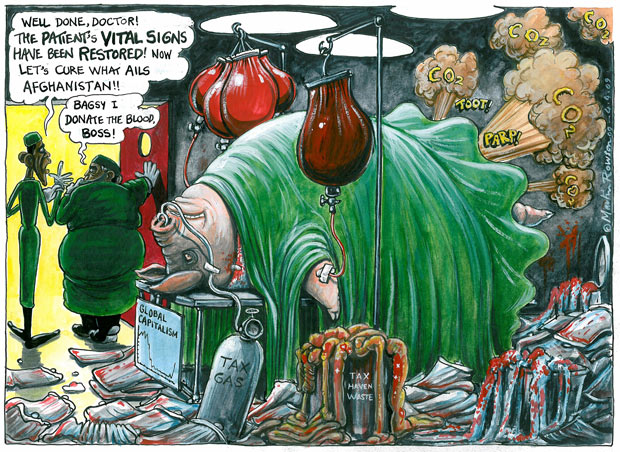


My tolerance for the fatphobia in these kinds of images has evaporated because I read them as an ongoing betrayal by people who might otherwise be comrades. I am not proposing that images be censored, and I don't want a visual language of fatness that is reduced to a happy-clappy set of 'positive images'. I want to be able to look at whatever I want as much as anybody else does, and I want to be challenged by what I see. With Rowson it's not even about being squeamish over grotesque pictures. What I would like is for progressive, freedom-loving people on the radical Left to think more about the complexities of representing fat and to stop selling out on people's bodies. Liberation cannot be built on stereotypes.
Ten Reasons to Love Burger Queen
I was cautiously optimistic when I first wrote about Burger Queen and now, having attended three out of the four events, I admit I was wrong to be so circumspect and can whole-heartedly say that it was absolutely brilliant in every way. Here are ten reasons why:
1. I've never seen anything like it in my life (and I've seen a lot)
Burger Queen went beyond any preconceptions I had about that stale irony-format, the beauty contest. Instead, it was like being immersed in a total environment where the focus was always shifting between performance, activism, weirdness, joy, anger, precious moments, and where real and fake were redundant terms. The Duckie performance influence is undeniable, I think, but it has its own distinct flavour (and smell, chips!), and I've never before seen performance of this kind applied to fat in such a skilful way.
2. Woah, activism
Looking at Burger Queen as a piece of fat activism, which it is but is also much more, makes me feel really excited about fat culture, especially that which is now happening right on my doorstep. There are so many ways in which it could develop, it doesn't have to follow the work I've seen, especially in the US, which is trad-burlesque heavy, or speaks to a lowest common denominator. Burger Queen is didactic but doesn't treat the audience like morons, offers a non-preachy pomposity-free polemic, is experimental and accessible, and it turns high concepts into a beautiful shared experience where rough and smooth all mix in together. This is what happens when people who get it use their talent and imagination to create something unique and wild.
3. The details that mattered
It's the little things that count, like the fact that you could buy a burger meal with your ticket, the Burger Queen staff uniforms, the fat-centric soundtrack, the being-on-TV jokes, the morbidly obese woman singing at the end of the night, the weekly diet, and the graphic design, to name but a few of them. It was a complete experience created by a team of enablers. It made me feel that I was in one of Scottee's demented fantasies, which is not a bad place to be.
4. Timberlina
I enjoyed all the Burger Queen performances but Timberlina's ukulele-assault on the cult of LighterLife was unforgettable.
5. It was messy
There were no tidy, nice, clean, respectable fat people at Burger Queen. No wannabe good productive citizens in sight. It was all about sweat, tears, being out of puff, having physical limitations, being in a strop, showers of chips and glitter, wobbling flesh, dirty cakeholes, genderfuckery, hairy bellies, sexuality, foul mouths, and low life (which of course is high life). Hallelujah for queered-up non-assimilationist fat people, there are few things more beautiful.
6. Fat is a politic
The idea that fat is a politic rather than a dress size was put forward in Burger Queen. I'll add the caveat that I think that fat is also about particular kinds of embodiment but luckily queer theory means that I don't have to reject one in favour of another, it can be both and more. Anyway, fat is a politic is a radical suggestion because it engages people of all sizes, it shows that everyone is implicated in fat and it incites people to do something about it. And this being uttered not at some exclusive academic conference, but at a pub in Vauxhall. I love that it supports multiple ways of being fat, and doesn’t offer these false binary divisions of fat/thin, or fat activist/fat ally. I have a similar thing with The Chubsters, which is a fat queer girl gang that you don’t have to be fat, queer, a girl, or remotely aggressive to be a part of. Hurray!
7. The people
The contestants, the judges, Jude Bean, the crowd. I wanted to be best friends with everyone and it gave me a bunch of new crushes to obsess over. Favourite contestant moment: being forced to wave my hands in the air by that out-of-control queen and dodging the sweets that she pulled from her face and hurled at people angrily.
8. Being a punter
If I want to be involved with fat activism usually what happens is that I have to either travel thousands of miles, or do it myself, or by myself. Burger Queen was the first time that I could just get on the tube and enjoy being in the audience. I could see that everyone was working like crazy, the stress of putting on something like this is major, but there was none of that on my part, just eye-popping fun and an event that felt as though it was made just for me. Bliss.
9. Queer-Disability-Fat
I did an MA in the early 90s and published a book in 1998 that applied disability theory to fat activism. I also wrote about queerness in that book but the feminist publishers believed that queer was the devil's work and wouldn't print that stuff. What delights me 13-20 years later is that Burger Queen comes along, crowns the gorgeous Nina Neon, and it's clear in the loveliest way that queer and disability and fat have a lot to say to each other and can interact with each other in fantastic ways. Burger Queen is theory that I helped develop reflected in reality, and done in a way that anyone can understand, with humour and style and humanity.
10. There's going to be another one next year
Yes, yes oh yes.
Burger Queen
What would it be like to wake up thin?
One of the questions that I was asked last week at King's College London was about how I might handle waking up thin one day (my answer: "That's never going to happen").
I gave a quick answer but this question deserves deeper thought because I think it is a product of various ideas about fatness, including:
It won't come as a surprise, but I don't subscribe to these ideas in relation to my own body. However, I do fantasise a lot about things. Often these are impossible supernatural things, like waking up and all the dead people I love are alive again; or about a more prosaic sadness, like waking up to find that I am adored and worshipped by someone who plainly doesn't adore or worship me in real life. Sometimes I dream about things that appear impossible but become more feasible when I pick them apart; waking up with unimaginable wealth is actually the desire to be able to do what I want with my life, to be able to help other people whenever I like, and not having to worry about paying for something, rather than sitting on a yacht with a bunch of supermodels. I think dreaming and imagining are crucial for anyone with an interest in social change; fantasy and desire, an imagining of something different, they are the first unformed, free-flowing steps to taking action.
Occasionally I harbour fantasies of having a different kind of body. Having a tail, a penis, the ability to project my thoughts out of my eyeballs like a film, or type anything just by tapping my fingers on a surface, being able to fly, to breathe underwater, to teleport, to grow or miniaturise myself, this is what I think about. I also wonder what it might feel like to have different impairments like some of the people I know. The fantasy of waking up thin is not really there, it's too boring, I just don't value slenderness in that way.
When I return to the original question I think I am being asked about the circumstances under which I would want to be thin. It boils down to this: it would be interesting to take advantage of the capital and privilege that comes with being normatively embodied for a couple of days, though I think this would enrage me to a level where I would struggle to function. I think Linda Bacon's 2009 NAAFA keynote, Reflections on Fat Acceptance: Lessons Learned from Privilege (.pdf, 128kb) is really central to the reasons why fat people might fantasise about becoming thin, it's about acessing power and privilege. This explains why people would risk the drastic and uncertain steps to realise normatively thin embodiment, and why this is problematic for anyone who cares about embodied diversity and the unequal distribution of power.
The question about waking up thin comes from a series of common values and beliefs that have become very alien to me and it's fun to take them apart and answer the question from my current standpoint. I'm intrigued, for example, by the way that very thin people can scooch up into tiny spaces, so I'd like to try that for, I dunno, 20 minutes or so before I returned home to my own body. It's a funny reversal of the fantasy, being thin is the temporary state in my mind's eye because when I think about it, who would I be without my body and my own history of fat embodiment? There's no way I would ever want to deny that precious stuff.
I gave a quick answer but this question deserves deeper thought because I think it is a product of various ideas about fatness, including:
- Fat people would rather be thin because obviously it's better to be thin
- There is nothing of value in being fat
- Bodies are choices therefore transformation is desirable and possible
- The fantasy of transformation from an unbearable present to a beautiful future is preferable to the struggle to make the present liveable now
- Disbelief that embodied self-acceptance is possible
It won't come as a surprise, but I don't subscribe to these ideas in relation to my own body. However, I do fantasise a lot about things. Often these are impossible supernatural things, like waking up and all the dead people I love are alive again; or about a more prosaic sadness, like waking up to find that I am adored and worshipped by someone who plainly doesn't adore or worship me in real life. Sometimes I dream about things that appear impossible but become more feasible when I pick them apart; waking up with unimaginable wealth is actually the desire to be able to do what I want with my life, to be able to help other people whenever I like, and not having to worry about paying for something, rather than sitting on a yacht with a bunch of supermodels. I think dreaming and imagining are crucial for anyone with an interest in social change; fantasy and desire, an imagining of something different, they are the first unformed, free-flowing steps to taking action.
Occasionally I harbour fantasies of having a different kind of body. Having a tail, a penis, the ability to project my thoughts out of my eyeballs like a film, or type anything just by tapping my fingers on a surface, being able to fly, to breathe underwater, to teleport, to grow or miniaturise myself, this is what I think about. I also wonder what it might feel like to have different impairments like some of the people I know. The fantasy of waking up thin is not really there, it's too boring, I just don't value slenderness in that way.
When I return to the original question I think I am being asked about the circumstances under which I would want to be thin. It boils down to this: it would be interesting to take advantage of the capital and privilege that comes with being normatively embodied for a couple of days, though I think this would enrage me to a level where I would struggle to function. I think Linda Bacon's 2009 NAAFA keynote, Reflections on Fat Acceptance: Lessons Learned from Privilege (.pdf, 128kb) is really central to the reasons why fat people might fantasise about becoming thin, it's about acessing power and privilege. This explains why people would risk the drastic and uncertain steps to realise normatively thin embodiment, and why this is problematic for anyone who cares about embodied diversity and the unequal distribution of power.
The question about waking up thin comes from a series of common values and beliefs that have become very alien to me and it's fun to take them apart and answer the question from my current standpoint. I'm intrigued, for example, by the way that very thin people can scooch up into tiny spaces, so I'd like to try that for, I dunno, 20 minutes or so before I returned home to my own body. It's a funny reversal of the fantasy, being thin is the temporary state in my mind's eye because when I think about it, who would I be without my body and my own history of fat embodiment? There's no way I would ever want to deny that precious stuff.
Look at this excellent fat sculpture
I don't have much of any substance to say today, mainly because I am still buzzing from the talk at King's College London last night. Thanks to everyone who contributed to that.
What I do have, however, is this amazing picture!

It's from the cover of the May 2011 issue of Museums Journal, the magazine of the Museums Association. It's there to illustrate an article about how science museums should get more hip and goes to show that a picture of a fat person or object perks up any old thing.
It turns out that the object is a sculpture that was exhibited in the Museum for the History of Science's Steampunk exhibition. I'm not much of a Steampunk aficionado so I haven't dug very deeply into the site and haven't been able to find much information about it other than that its title is Cosmonaute and it was made by Stéphane Halleux. There are more pictures on Stéphane's site.
The magazine image is accompanied by the headline 'Brave New World,' which I like because it subverts the notion that obesity heralds the end of the world. I've documented previous artistic explorations of fat that I think have failed dismally, but this object is different. I love it, from its tiny and cute three-digit hands to its truncated feet and blank/wonderous expression. Its apparent inflatedness reminds me of the lovely Horniman Walrus, which is no bad thing. I like the way it appears to hover lightly, as though gravity is no longer relevant.
The sculpture's shape recalls friends and acquaintances who look a bit like this. It makes me think that fat activists should have tool belts, gauges, dials and protective headgear as we navigate and explore the outer reaches of culture and embodiment.
What I do have, however, is this amazing picture!

It's from the cover of the May 2011 issue of Museums Journal, the magazine of the Museums Association. It's there to illustrate an article about how science museums should get more hip and goes to show that a picture of a fat person or object perks up any old thing.
It turns out that the object is a sculpture that was exhibited in the Museum for the History of Science's Steampunk exhibition. I'm not much of a Steampunk aficionado so I haven't dug very deeply into the site and haven't been able to find much information about it other than that its title is Cosmonaute and it was made by Stéphane Halleux. There are more pictures on Stéphane's site.
The magazine image is accompanied by the headline 'Brave New World,' which I like because it subverts the notion that obesity heralds the end of the world. I've documented previous artistic explorations of fat that I think have failed dismally, but this object is different. I love it, from its tiny and cute three-digit hands to its truncated feet and blank/wonderous expression. Its apparent inflatedness reminds me of the lovely Horniman Walrus, which is no bad thing. I like the way it appears to hover lightly, as though gravity is no longer relevant.
The sculpture's shape recalls friends and acquaintances who look a bit like this. It makes me think that fat activists should have tool belts, gauges, dials and protective headgear as we navigate and explore the outer reaches of culture and embodiment.
One of the most extraordinary experiences of fat embodiment in my life
 |
| The Hot Bath, where I had my treatment |
I went to Thermae Bath. This is the thermal baths complex in Bath, in Somerset. I'll try and explain this without being too confusing. Bath is a town. There are remains of Roman baths there, you can visit them to look but you cannot bathe in them. For a long time you could bathe in other baths in Bath, but then they closed. A new bathing complex was opened a few years ago. This complex comprises an inside pool, an outside rooftop pool, some steam rooms, and a hot bath where treatments are given. There is a separate building with a smaller bath. The baths are the only place in the UK where you can bathe in water heated by geothermal activity. Bath is also Britain's most well-known spa town, but that's another story.
(Quick and grumpy aside: If you are fat, the robes at Thermae Bath will not fit you, but the receptionist will insist "You'll be okay" without listening to you when you ask what size they come in. Although people of many sizes come and bathe at the baths, the robes only come in one standard size that does not cover someone of my size. This is extremely annoying, especially given that the complex has otherwise really good access for disabled people. I don’t know why they don't have some larger robes available. I have been to bath houses in Japan, a country where people tend to be much smaller than me, and I have been adequately clothed there, but not at Bath. Tip for fat people: bring your own.)
Thermae Bath at peak visiting time is not relaxing in the way that the brochure pictures promise. It is heaving with people who do not know about spa etiquette. So there is a lot of loud chatter, dashing around, and people seem unable to switch off and just experience the heat, the water, the ambiance. My girlfriend and I let go of our fantasies of having the place to ourselves and bobbed around in the warm water with everyone else. It was not a holy experience, but it was fun and relaxing in its own way.
The baths are a great place to witness yourself amongst a spectrum of bodies, to see the myth of bodily normativity at first hand, and to treat your own body with gentle kindness. Bobbing, floating, sweating, napping, all feel good. Going to the baths is not the only way in which I have learned to feel okay in my own skin, but it's part of the story. I would love to see a fat activist reclamation of David Walliams and Matt Lucas' hate-filled Little Britain stereotype Bubbles DeVere. I resent that mean appropriation of my fat, naked, spa-loving self!
 |
| The hot bath from outside |
So I had a treatment whilst I was at Thermae Bath. I'm almost embarrassed to say it because the name of the treatment – Watsu – sounds like so much orientalist mumbo-jumbo. I've since found out that it's a portmanteau of water and Shiatsu, a type of massage that emphasises pressure points. The evidence that Shiatsu is effective treatment for disease is unconvincing, but it feels really good. Watsu was invented by who else but a California hippy called Harold Dull in 1980, fact fans. Few people offer it in the UK because there aren't many pools appropriate for it. It can be very pricey and my session was no different, though I didn’t pay for it, it was a belated xmas present. I chose to have a Watsu session not because I am diseased, but because I wanted to be swished around in the water for an hour and can just about handle its inherent bourgie woo. I knew that Watsu would feel nice and relaxing but I wasn't expecting the experience to be as intense and strange as it was.
My session took place in the Hot Bath, a stunning pool at the centre of the building. I've included pictures of it here. When I looked up I could see clouds and sky through the glass roof. There was some music playing in the distance, and gurgles and pops made by the water, but the setting was incredibly serene, almost like a virtual reality environment.
My therapist was called C. It was just us in the pool. She told me what she was going to do and tied some floats to my legs. Two didn’t fit but there was no fuss and I am plenty buoyant anyway.
We did some breathing together, our bodies rose and fell in the water as our lungs filled and emptied with air. C invited me to lean back into her arms when I was ready. She took my head and swished me around, pulling and turning me. I looked up at the sky and then closed my eyes for the rest of the session.
 |
| What I saw when I looked up |
The whole session felt extremely intimate and special. I felt changed by it. I don't know if this was because I had been able to relax and trust that I would be okay, I think it may have something to do with surrendering to vulnerability in the water and allowing myself to be cared for. I have various histories of abuse to my name, which I have been thinking about a lot lately, and it felt mind-blowing to be held physically in this way. There is something about the way this takes place in warm water, too, which feels very elemental, and is somewhere I feel at home.
I was aware of how close our bodies were during the treatment and this could be disturbing if you didn't trust the person doing it. C's head was close to mine, I was in her arms almost all of the time, and my hand brushed past her breast and her armpit at various stages. There was intense eye contact. I was aware that my magical moment was work to her, and I thought about the treatment as being on a spectrum of embodied work that includes other kinds of massage and sex work. I felt like a John of sorts, but perhaps this is the only way I can rationalise this kind of gendered, paid-for, embodied experience.
I felt very moved that C was able to handle me. There's something really amazing when young and pretties (my girlfriend's term for normatively embodied people, perhaps those who have never encountered non-normative embodiment, or fear or deride it) are able to treat people with bodies like mine with respect. Being old, unruly, hairy-legged, ungroomed, fat, scarred, wobbly, messy, and all the rest of it does not always send people running for the hills – who knew?! It is absolutely brilliant when people who may not be in the firing line themselves step up and show that they have done their work. C looked after me and modelled ways in which I might care for myself. Thank you!
I thought of the journey I've taken with my body, how many fat people, people, would not be able to do what I did, and not just because of financial or other practical access reasons either. It was almost too enormous to think about, and I still feel that I could become a big blubbering mess if I thought about it deeply, so maybe I'll come back to that in a while, or take my time in picking it apart.
How did this all end? I walked back to the pool to see Kay, grinning, full of wonder, and with a profound sense that I'm alright, really.
Fat Accessibility on São Paulo's Metro

Jenni has generously allowed me to use some of the commentary she gave on her LiveJournal. She says:
I was interested that the São Paulo Metro is so inclusive in ways that the London Underground mostly isn't – we've benefited from the enhanced accessibility ourselves, as the 'special needs' I meant include people with babies, people with luggage, older folks, pregnant women, and a range of others as well as wheelchair users. I'm not entirely sure whether the seats in question are intended as part of this accessibility (which might mean that the authorities are problematically treating fatness as a disability) or as part of some other initiative which might be being done in a more pro-different sizes way, but I was interested to see it precisely because of your fat activism writing, which makes me think about that sort of question. Brazil is in some ways a very body-fascist place – the breakfast in the hotel included calorie counts for all the foodstuffs, and the women are supposed to look chic and be skinny, to the extent that I once failed to buy some beach shorts because I couldn't get the supposedly large size any higher than my knees. At the same time though you see an amazing variety of body shapes on the street, on the telly, and on the beach, so I don't know how those pressures actually work out in everyday life, and I wonder about it.Jenni goes on to say:
The seats are weird and interesting. The state law in question is specifically to combat obesity and is part of 'Lighter São Paulo' (São Paulo Mais Leve) but I don't see how the seats work out as any sort of countermeasure. They fit into the same category as seats for elderly or pregnant people or those carrying children, in that the seat is not supposed to be used by people who aren't in that situation unless there is no-one around whom has a better right to it. There are fewer specific seats for fat folks than for old folks but otherwise it's supposed to work in the same sort of way as for categories of people who no-one would deny a right to preferential treatment, so arguably preferential treatment is here being given where it is normally withheld. There is a seat on the platform and a matching seat in the carriage that stops at that bit of platform – that's a carriage that also has space for bicycles, wheelchair users, and pregnant/old/baby-carrying folk (though the latter have lots of specific seats and not just in this carriage).Jenni posted some pictures on her Flickr and also pointed out this article São Paulo um cidade Chubby friendly*?. Here, too, is a news report in Portuguese 'Banco dos gordinhos' do metrô agrada também os magros.
On our various Metro trips in SP far, we have seen one fattish chap sat in one of the seats on the train – clearly he didn't mind sitting there whether or not he would officially 'count,' I mean he mustn't have been embarrassed by it or anything. On the seats on the platform we only saw a canoodling couple using it as a love seat (neither of them were skinny but they weren't fatties either – again they didn't seem embarrassed to be sat there so I suppose they weren't sensitive about their weight or anything) and a mother and young son, aged maybe 10 or so, just using it as an extra-wide seat.
I really love the contradiction that Jenni points out between anti-obesity initiatives, which tend to be about eradicating fat people, and these seats, which support the lives of fat people as we are. Installing seats across a large transport network is a public investment in fatness and suggests that fat people aren't going away any time soon. Where the seats are framed as some kind of response to 'obesogenic environments', ie getting fat people out and about and doing things, the rationale may be fatphobic but the outcome is about creating inclusive space.
Newspaper reports typically state that fat people are too stigmatised to use the seats, but the seats make me feel excited at the idea of confident fat people using them, which must surely happen. It would be amazing to see that.
I also like the way that the seats ally fatness, disability and accessibility. Firstly it shows that accessibility is more than disability, and secondly, although the relationship between fat and disability can be filled with tension (see my paper from 1997 Can A Fat Woman Call Herself Disabled?) I see them as very much intertwined.
These seats have blown my mind in all kinds of ways, which means I have questions that may not have answers: why have seating that delineates a body size at all? Why not go for bench-style seating in public space? Are thinner people required to relinquish a fat seat for someone fatter? What if there's more than one fat person, how is who uses the seat negotiated? What if fat seats are still too small for you? Have you used one of these seats?
Thanks Jenni!
Some Benefits of Being Fat
I'm always especially bummed out when left-wing, feminist or otherwise progressive media fail to address fat in a way that is sufficiently critical for me. Jezebel used to be better but now reiterates tired weight loss rhetoric, The Guardian is openly fatphobic, and Sociological Images can never seem to quite go the full distance and critically engage with the fat, possibly because of its legions of fatphobic commenters. Some Benefits of Being Fat, a recent post, is a good example.
Here a fat woman is deemed to be non-sexual, and fat is a protective layer against unwanted abuse by men. These claims are nonsense. Just one peek at, say, The Adipositivity Project, disproves the former, and any fat woman could tell you stories of harassment, sexual or otherwise. It's like a Looking Glass version of the 'she was asking for it' discourse in relation to sexual violence and upholds the myth that only pretty girls get raped. This argument supports the idea that the authentic person, one's inner truth, is always thin, that fat is always extraneous and therefore disposable. It also buys into the notion that bodies are entities of choice, and that such choice is not part of discourses of fat hatred.
This pithy little post demonstrates the pernicious influence of a certain kind of feminist psychoanalytical thinking about fat, championed by Susie Orbach and her Women's Therapy Centre in the 1970s. It also demonstrates the lack of critical engagement with that discourse within sociology, feminism, and social science in general. By failing to locate this discourse the post retreats into unsubstantiated truth claims, a kind of 'but everybody knows it to be true' mentality, which is ironic given that sociology is supposedly about unpicking such allegations. I think the post also supports the idea of sociologist as unbiased observer, a mere vessel that articulates the facts - bunkum! It makes me wonder about the author's relationship to fat, whether or not they believe that fat actually protects women from harassment, whether they are fat, etc.
By suggesting a couple of shitty imagined benefits, the Sociological Images post is basically saying that there are no benefits to being fat. Thanks folks! But this is not a universal truth either. There are benefits to being fat, and these might be different for everyone. For me these benefits are not just about fat but also things like skill, luck, work, etc. Anyway, shall I name some of them?
Benefit! I like the way my body looks and feels, and other people like it too. The struggle of self-acceptance and self-esteem I underwent when I was younger has paid off in golden years of embodied happiness, with only occasional excursions into ambivalence.
Benefit! I did an MA about fat politics and got a distinction. The research for that project went on to become a book, which I published when I was 29. The book was and is taught in universities. People often tell me that it changed their life and, 13 years on, I still get fan-mail for it, and enjoy seeing battered and underlined copies of it in libraries.
Benefit! I've been invited round the world to speak about fat. As I write this, I'm sitting in the sunshine in a beautiful house in Hamburg where I have been Artist In Residence for a couple of weeks, in which I'm being supported to make a zine of the Queer and Trans Fat Activist Timeline that a bunch of people co-constructed in California last year.
Benefit! Not only am I doing a PhD about fat activism for free, I'm being paid to do it.
Benefit! I'm a part of many rad communities of fat people who are organised, politicised, and using every means necessary to create liveable lives for themselves, and for everyone.
Benefit! Fat gives me a way of understanding things, it's a kind of lens that I draw upon in conjunction with other theoretical frameworks. It has revolutionary potential.
Benefit! I get to see and participate in marvellous, eye-popping, life-affirming things that I would never have access to if I were thinner and had not lived a fat life.
What are other benefits of being fat? Silly, serious, share them here if you feel like it.
Here a fat woman is deemed to be non-sexual, and fat is a protective layer against unwanted abuse by men. These claims are nonsense. Just one peek at, say, The Adipositivity Project, disproves the former, and any fat woman could tell you stories of harassment, sexual or otherwise. It's like a Looking Glass version of the 'she was asking for it' discourse in relation to sexual violence and upholds the myth that only pretty girls get raped. This argument supports the idea that the authentic person, one's inner truth, is always thin, that fat is always extraneous and therefore disposable. It also buys into the notion that bodies are entities of choice, and that such choice is not part of discourses of fat hatred.
This pithy little post demonstrates the pernicious influence of a certain kind of feminist psychoanalytical thinking about fat, championed by Susie Orbach and her Women's Therapy Centre in the 1970s. It also demonstrates the lack of critical engagement with that discourse within sociology, feminism, and social science in general. By failing to locate this discourse the post retreats into unsubstantiated truth claims, a kind of 'but everybody knows it to be true' mentality, which is ironic given that sociology is supposedly about unpicking such allegations. I think the post also supports the idea of sociologist as unbiased observer, a mere vessel that articulates the facts - bunkum! It makes me wonder about the author's relationship to fat, whether or not they believe that fat actually protects women from harassment, whether they are fat, etc.
By suggesting a couple of shitty imagined benefits, the Sociological Images post is basically saying that there are no benefits to being fat. Thanks folks! But this is not a universal truth either. There are benefits to being fat, and these might be different for everyone. For me these benefits are not just about fat but also things like skill, luck, work, etc. Anyway, shall I name some of them?
Benefit! I like the way my body looks and feels, and other people like it too. The struggle of self-acceptance and self-esteem I underwent when I was younger has paid off in golden years of embodied happiness, with only occasional excursions into ambivalence.
Benefit! I did an MA about fat politics and got a distinction. The research for that project went on to become a book, which I published when I was 29. The book was and is taught in universities. People often tell me that it changed their life and, 13 years on, I still get fan-mail for it, and enjoy seeing battered and underlined copies of it in libraries.
Benefit! I've been invited round the world to speak about fat. As I write this, I'm sitting in the sunshine in a beautiful house in Hamburg where I have been Artist In Residence for a couple of weeks, in which I'm being supported to make a zine of the Queer and Trans Fat Activist Timeline that a bunch of people co-constructed in California last year.
Benefit! Not only am I doing a PhD about fat activism for free, I'm being paid to do it.
Benefit! I'm a part of many rad communities of fat people who are organised, politicised, and using every means necessary to create liveable lives for themselves, and for everyone.
Benefit! Fat gives me a way of understanding things, it's a kind of lens that I draw upon in conjunction with other theoretical frameworks. It has revolutionary potential.
Benefit! I get to see and participate in marvellous, eye-popping, life-affirming things that I would never have access to if I were thinner and had not lived a fat life.
What are other benefits of being fat? Silly, serious, share them here if you feel like it.
Queering Fat Activism: Burger Queen

What are fat activists to make of this beauty contest which revels in fast food, excess and carefree attitude? It seems a far cry from what Katie LeBesco identifies as the will to innocence in fat activism, ie the assertion that fat people are not responsible for getting fat, don't choose to be fat, and can't change. It also seems far away from healthism in fat activism, exemplified by images of beaming salad-loving, yoga-doing fat folk. It doesn't really fit more common-or-garden forms of fat activism, such as refuting health claims made against obesity, fashion consumerism, or placard-waving protests.
Burger Queen takes on the appearance of fat lib – 'fat is a politic' – but also revels in themes that would upset orthodox fat activists. I'm talking about greed, love of grease, grotesqueness, nihilism. It breaks the rules, not least because of its resident judge, Amy Lamé, who is both a great supporter of fat activism in the UK, and also appeared on Celebrity Fit Club. Intentional weight loss is a big no-no in many fat activist quarters, and weight loss reality shows have often come under fire for whatever it is they're seen to be promoting.
So what is this politic? For me there is a flimsiness about Burger Queen as a political statement. Revelling in burgers and chips as a refutation of healthism is too neat a mirror-image flip, it maintains a relationship with dominant ideas about "the obese" when it could be going off on a much weirder and wilder tangent that has nothing to do with obesity rhetoric and everything to do with creating autonomous fat culture. So for me it doesn't quite go far enough.
I'm interested in new forms of fat activism that have or don't have a relationship to feminist fat activism of the past. It's fascinating how ideas mutate and fall back on themselves. I think it's great that Scottee is not bound by what has become fat activist orthodoxy, and neither can he be neatly compartmentalised as a Bear – the only other option available to fat queer men at the moment, apparently. But I also wonder if he knows about this great movement, and if he is incorporating it into his work. For example, when Scottee raised a few eyebrows at The Fat of The Land: A Queer Chub Harvest Festival, with his apparently sincere poem about a tragic fat girl did he know that he was rubbing people (who were looking for 'positive images' of fatness) up the wrong way? Was he being ironic and confrontational? Was it something else? On the other hand, Burger Queen is absolutely coming from fat activist tradition, in which people use the forms of activism most available to them, in Scottee's case it's queer performance art. The beauty contest, too, although well-worn, has been a site for fat activism in the past.
What Burger Queen reinforces for me is my disillusionment with what I thought were the certainties of fat activism. When I started my research into the movement I was pretty sure I had a handle on what was and what was not fat activism. A couple of years on those ideas have been erased only to be replaced with a growing discontent with the side-effects of certainty: boundary-policing, intolerance, a prudishness about the down and dirty ways in which some people talk about fat or embody fat, the divisions between good fat activists and bad fat activists. So I'm keeping an open mind about Burger Queen, I'm looking forwards to seeing how it turns out, and I'm hopeful that it will be part of a queer turn in fat activism, work that messes up fat, makes it unruly and complicated, not nice, safe, or easily knowable.
I heart Becoming Chaz

Fenton Bailey and Randy Barbato's film was a hit at Sundance and is going to have its TV premiere on the Oprah Winfrey Network. Becoming Chaz follows Chaz Bono as he negotiates his transition from female to male, including undergoing medical procedures and encounters with family, friends, activism and fame. A good chunk of the film is devoted to his relationship with Jennifer Elia, who is depicted as a fully-formed and multifaceted person in her own right. Cher also features, predictably, and the film-makers offer a compelling glimpse behind the Hollywood myth factory that she represents. Anyway, the film was a highlight of the festival for me, its warmth and complexity was unexpected and welcome. Chaz and Jenny rule.
Readers of this blog will know that I think Chaz Bono is a powerful fat and trans role model and all-round great guy. I've tried to make contact in the past and have been fully rebuffed! I still think this is a shame but, having seen this film, I understand why fame makes it impossible for Chaz to make any public comment about this stuff.
Anyway, given this, I was interested to see how Chaz' fatness was addressed in the film. It will come as no surprise that there was little in the way of any trad fat lib analysis, but Chaz appears very at home in his body. Post top surgery there were many shots of him splashing around in various swimming pools, apparently unfazed with public semi-nudity, hurray! Jennifer referred to his top surgery as conferring a minor weight loss, ie his body no longer has the weight of his breasts, but he seemed unconcerned. He talked about his role model being a stocky man, and he appeared not to buy into fatphobia at all, onscreen at least. Go Chaz!
As for me, it was a total pleasure to sit in a packed screening of 400 people and see a feature-length documentary about a fat trans guy, and to see his embodiment right there, bigger than life, on a huge screen, and to know that people were witnessing it sympathetically. People will, no doubt, critique its representation of trans identity, but for now it reminded me that a) I want to see more tales of transmasculine fat, b) Becoming Chaz adds a lot to the currently fairly minimal body of work on men and fat, and c) it's great to see unapologetically fat people on screen. Also, I wish RuPaul would come round for a playdate with me.
Here's the cheesy Oprah Winfrey Network trailer for Becoming Chaz:
Posing for Substantia Jones

One of the people I spent some time with is Substantia Jones, the photographer behind The Adipositivity Project. If you are unfamiliar with Adipositivity, go to the site right now and feast your eyes on the amazing variety of fat flesh. This is one of my go-to places if ever I am having a bad fat day – and when I'm feeling perfectly fine too.
Substantia took my photograph in 2009, I'm Adiposer 303, 379 and 413, and just last week she did it again. Here's the pic that appeared on the site today, number 442, and outtakes of me with Mickey, and a snowman in Chinatown. By the way, yep, it was very cold, I got undressed in a restaurant toilet and dressed again out on the pavement, they're real streets in Chinatown in Manhattan, there were comments from passers-by (the guy in the main pic wanted my number – no chance!), it's as true as you see it.
When we were talking beforehand, Substantia asked me what it was like to pose for Adipositivity. I gave a jumbled up response, so I thought I'd try and give a more considered answer here.
I love the Adipositivity aesthetic, which is totally at home with femme and queer identity, often full of delicious colour, witty, sexy, imaginative, and stuffed with personality and style. Substantia has great visual ideas an collaborative skills, she makes the shoot fun, an adventure. When Substantia takes your photograph, you enter this world too and you get to see yourself within this frame, literally. It's a gift considering that many of the people who are photographed grew up with body shame and self-hatred.
When you appear on the site it's a measure of how far you've come in refuting fatphobia. It's not only about having your picture taken and allowing others to see it, it's also about being able to look at your own image without terror or disgust. Being there is a way of showing that having a fat body is alright, it gives permission to be visible and unafraid. There you are, part of humanity, not the fattest, not the thinnest, not the prettiest, or any other category that is supposed to be important, just there, doing your thing.
You could say that Adipositivity is a means of creating a new kind of beauty, or appreciating beauty. I don't think that beauty is the only thing going on in the pictures, they are also about flaunting fat, sometimes quietly and shyly, sometimes not. I love that the photographs are 'positive' but that they are never trite or monodimensional, 'positive role models' is an expression that makes me want to burn and rob, and I never get that feeling looking at these images. Instead they suggest another way of being, a richer way of considering fat embodiment. There is nothing apologetic or placatory about them and I think that this is because they are not necessarily created by and for 'them', but by and for 'us'. Whenever I come across the photographs they make me want to climb inside the frame and inhabit the world in which they were taken, I've been lucky enough for this to actually happen to me.
I come from punk and I appreciate that although Subsantia's photographs have high production values, they also strongly support a DIY ethic. Adipositivity is put together on next to nothing, it uses available resources, easily accessible web technology, for example, and also manages to have a really powerful impact. It is created without the pressure of advertisers, completely on Substantia's own terms.
It sounds cheesy but I'm really proud to be part of this project, grateful to have an opportunity to pose, and glad of Substantia's friendship. Although I live far away from New York, being an Adiposer makes me part of a community that wants to see images like these and is ready to help make them happen. I love seeing myself within this context and am delighted to be able to offer it my embodied support.
PS This still seems inadequate. Oh well, I'll write more next time, hopefully there will be a next time.
Subscribe to:
Posts (Atom)
 |
 |
 |
 |
 |
 |
 |
 |
 |
 |
 |
 |
 |
 |
 |


